

The 'Open Sandwich' Generation
What happens when the slices come off

There’s a particular quality to the silence on a Sunday morning when nobody needs you.
I don’t mean nobody in the world. I mean nobody in the small, private, three-generational world you’ve been carrying on your back for the last thirty years. No teenager hammering on the bathroom door. No “have you rung your mother?” No school run, no homework crisis, no medical appointment somebody needs ferrying to. Just you, in a quiet kitchen, in a quiet house, on a quiet Sunday, with a cup of coffee and no item on the list that involves anyone else’s diary.
It feels, the first few times you notice it, almost rude.
The sandwich, and the open one
You’ll have heard of the sandwich generation. It’s been knocking around since the eighties, sociologists’ shorthand for the people pressed between two layers of dependency. Ageing parents above, growing and dependent children below, and you, in the middle, doing all the lifting. Calls from the care home in one hand, the school WhatsApp group buzzing in the other. The ‘filling’ in others’ lunches.
What nobody’s quite named yet, and what I think we ought to, is what happens when the slices come off.
Your parents pass, one at a time, with all the grief and slow administration that involves. Your children leave home, properly leave, with their own partners and their own jobs and their own opinions about everything you used to be the authority on. And one Tuesday afternoon, you look around and realise that for the first time since you were eighteen, you are not the support layer for anyone but yourself.
You are an open sandwich.
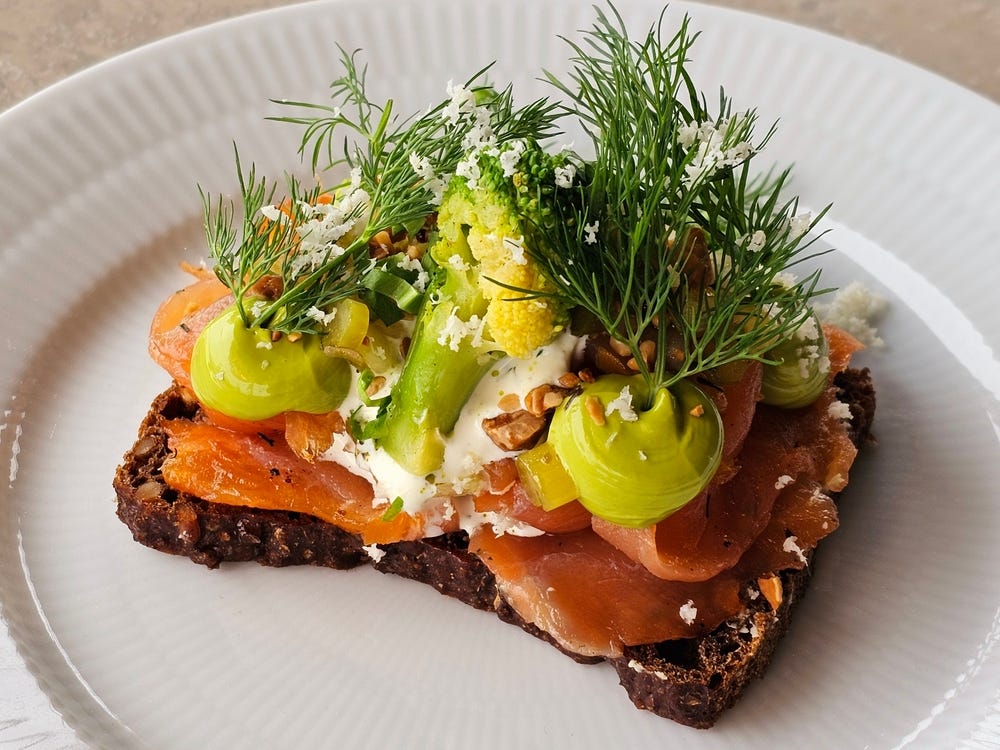
Single layer. The top is air. The thing on the plate, properly visible, is no longer the middle of anyone else’s structure. It’s the Danish model. Smørrebrød. Less covered. More exposed. Possibly more honest.
It is, on the whole, a stranger experience than anyone tells you.
The lightness that surprises you
The first thing the open sandwich gives you, and the bit that feels almost unseemly to talk about, is genuine and unfamiliar lightness.
You don’t have to ring anyone before you go out. You don’t have to factor anyone else’s appetite into Saturday’s dinner. You don’t have to be home by a particular time. You don’t have to keep one eye on your phone in case it’s the care home. You don’t have to hold the family together with logistics, which, if you’re honest, was about 60% of what holding the family together actually meant for the last three decades.
You can, in fact, decide on a Wednesday afternoon to drive to the coast, and you can do it without telling anybody, and nobody will worry about you, and nobody will need anything from you while you’re gone, and you can sit on a bench eating a Cornish pasty and watching the sea, and the only person you have to answer to is the version of yourself who’d quite like another cup of tea before the drive back.
This is, objectively, a kind of freedom most adults have not experienced since they were nineteen.
What nobody quite tells you is how disorienting it is.
The grief that becomes weather
Here’s the bit underneath the lightness, because there has to be one.
Both your parents are gone. That doesn’t go away. It doesn’t even quieten down particularly. It just stops being a sharp event and starts being something more like the weather. Some mornings you don’t notice it at all. Some mornings you reach for the phone because you’ve thought of a thing you wanted to tell your mum, and you’re halfway through unlocking the screen before the realisation lands again, fresh as the first time, and you have to put the kettle on and stand still for a minute.
There’s no resolution to this. There’s no “moving on.” There’s just a slow, decade-long arrangement you make with the absence, where it stops being a wound and starts being a feature of the landscape. You walk around it. You incorporate it. You make jokes about it eventually, with the kind of dark, dry, slightly inappropriate humour that we British have always reserved for the worst things in life.
And the children, in their own way, are also a kind of present absence. They are alive and well, thank goodness, and they ring on Sundays, and they come for Christmas, and you love them in a way that has rearranged itself for adulthood. But you are not central to their daily life anymore, in a way that, if you let yourself sit with it, is also a small ongoing grief, the kind that has nowhere to go because, of course, you wanted this. You raised them to leave. They left. Job done, please collect your certificate from reception.
The lightness and the grief, it turns out, are not opposites. They share the plate.
The strange new weight at the top
The other thing nobody mentions is that you are now the senior generation.
There is, in your family, no longer anybody above you. No grandparents on the phone with the kind of wisdom that only people born before the war could deliver. No parents to ring with the small worries you used to outsource upwards. The buck, for the first time in your life, stops with you. Not in the dramatic adult-responsibility sense (you’ve had that for forty years), but in the quieter generational sense, which feels surprisingly different.
You are the one your nieces and nephews send a Christmas card to first. You are the one expected to make the speech at the family wedding. You are the keeper of the family history, the rememberer of the dead relatives, the explainer of who-was-married-to-whom and what-happened-to-the-house. When the next generation has a question about anyone older than them, they come to you, because there is nobody behind you to ask.
It’s an oddly weighted promotion. Nobody hands you a card. Nobody throws a party. You just notice, at some funeral or other, that you’re now sitting in the row your parents used to sit in, and that the row in front is empty.
This is not a complaint. It is, I think, one of the great quiet privileges of a life lived long enough. But it’s a privilege nobody warns you is coming, and most people, in my experience, don’t notice they’ve taken it on until they’re a year or two into it.
What the open sandwich asks of you
Here’s the bit that catches people out, and where the cheerful lightness of the open sandwich quietly becomes a test.
For thirty or forty years, what you spent your life doing was decided, in large part, by the people on your slices. The kids needed feeding, ferrying, and supporting through exams. Your parents needed visiting, advocating for, and talking to on a Sunday afternoon. Your time, your money, your emotional energy, all of it found its shape in relation to the people who depended on you.
Now that those people don’t or aren’t there, what does your time get spent on?
This is, for a surprising number of people, an unexpectedly difficult question. They have been the supporting cast in their own life for so long that they’ve forgotten how to be the lead in it. They’ve spent forty years answering other people’s questions and now have nobody asking. They are, technically, free, and what they discover is that freedom without a structure to spend it on isn’t liberation, it’s a vacuum.
The open sandwich tells you the truth about who you are when nobody needs you. And the truth, for a lot of us, is that we don’t quite know.
How to be an open sandwich well
I don’t want to do five moves on this one. The five-moves approach is for when something is broken and needs fixing. The open sandwich isn’t broken. It’s just unfamiliar.
But three observations, I think, are worth offering.
The first is that the open sandwich needs filling, but only by you.
If you wait for life to put something on top, you’ll wait for a long time, because the great structuring forces of your previous life — work, parenthood, parental care — are mostly behind you now. The new filling has to be chosen. Travel. Friendships. New skills. New tribes. Causes. Projects. The slow rebuilding of the marriage. Whatever it is, you have to bring it yourself. The plate doesn’t fill itself, and a plate left empty for too long becomes a vacuum, and vacuums in human life get filled by drift, low-grade unease, and an unhelpful amount of social media. Better to choose.
The second is that the lightness is real, and you are allowed to enjoy it.
The guilt about feeling light when your parents have died, and your children have moved on, is, I want to be clear, completely understandable and also completely optional. Your parents, if they were anything like most parents, would be delighted that you were having a coffee on a Tuesday afternoon. Your children, similarly, do not in fact want you sitting at home worrying about them. Freedom is a gift they would both want you to use. Use it.
The third is that the grief belongs in the plate too.
This is where most British men, in particular, get the open sandwich wrong. They treat the grief as something to push to the side, like the sad bit of garnish that’s spoiling the picture. It isn’t. It’s part of what’s on the plate now. The ongoing low-level awareness that your parents are gone, the strange grown-up love you have for your adult children, the new senior role at the top of the family — all of it is the meal. You don’t have to fix the sad bits. You have to live alongside them.
The retirees who genuinely thrive at this stage of life are not the ones who managed to feel only lightness. They’re the ones who learned to hold both, on the same plate, on a Sunday morning, with a cup of coffee, without flinching.
The Scandinavian thing
There’s a reason I keep coming back to smørrebrød.
The Danish open sandwich is, when you actually look at one, a much more beautiful thing than the closed British equivalent. It is composed. It is deliberate. Every element on it is chosen because it earned its place, not because it was the only thing in the fridge. You can see exactly what it is. There is nothing hidden, nothing wedged between two slices to disguise it. It looks, in a way that not much British food does, like somebody thought about it.
That’s the model, I think.
The open sandwich generation has a choice that the sandwich generation never had. You can compose the plate. You can choose what goes on it. You can decide, at sixty or sixty-five or seventy, that you are going to be more deliberate about how you spend your remaining time and energy than you have ever been about anything in your life. You can leave the bits off that you don’t want. You can put on the bits you’ve been meaning to for years.
It is, on balance, a better deal than it looks.
It’s a different shape, certainly. Less filled in. More exposed. Some days, more lonely.
But also more honest. More chosen. More yours.
And eaten properly, with a decent coffee, the open sandwich is one of the best meals there is.
Beautiful and thought provoking. Thank you.
This was quite lovely and insightful. Thank you.